Today, I had the pleasure of speaking with Katharine of Hidell Brooks Gallery in Charlotte, North Carolina, via Instagram live stream about my current painting exhibition. You can watch the full live stream here:
But in case you’re a bit short on time, here are five highlights.
1. Yes, that giant fudge ripple cone painting took two years to paint.
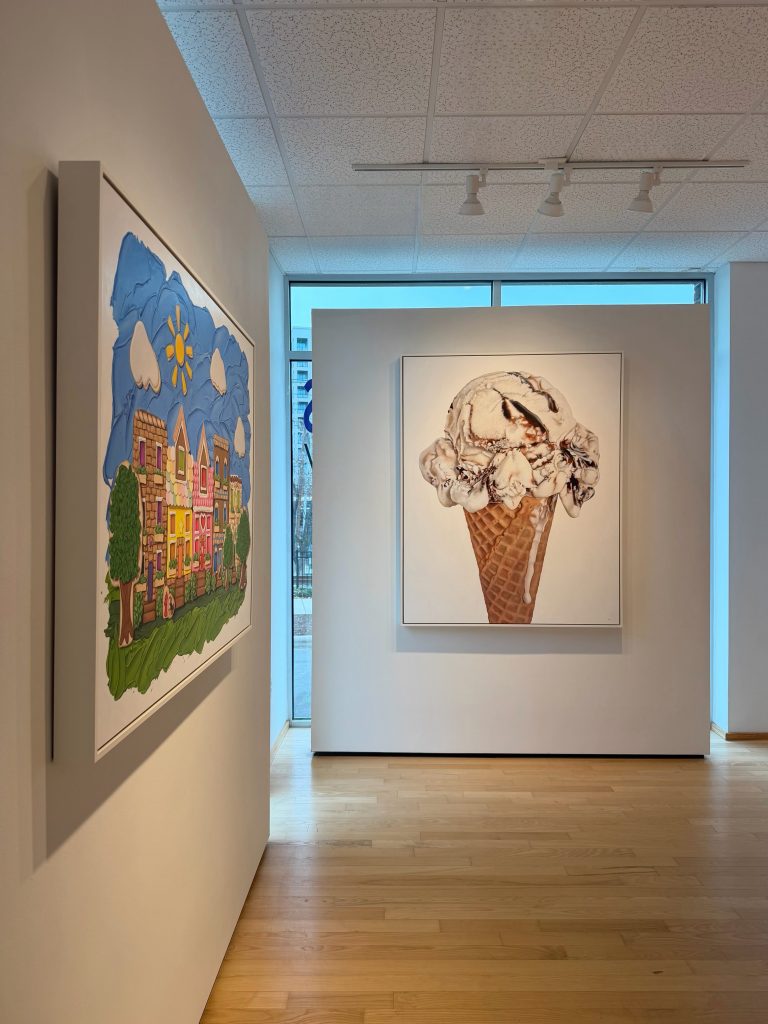
No joke, two years from start to finish on this 60″ x 48″ painting — the biggest thing I’ve ever painted. Big breaks along the way, of course, but ultimately it was the skills that I acquired during this last year of painting the complex pieces for this show that enabled me to get this piece across the finish line.
It’s not only the biggest piece I’ve ever painted, but I think it’s the most realistic cone I’ve done, too. You can read more about it in my recent blog post, “Why I Almost Didn’t Finish My Largest Painting Ever.“
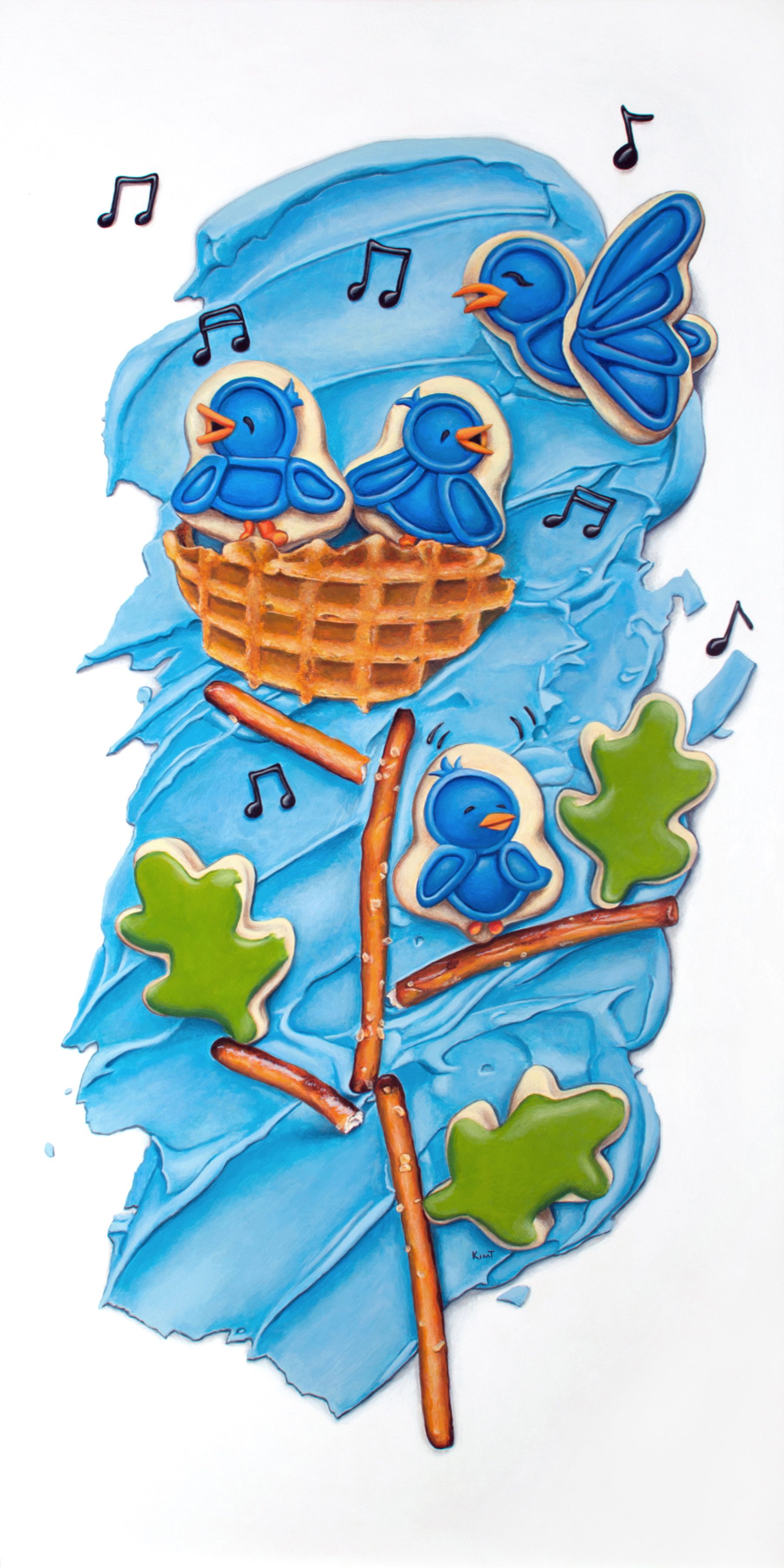
2. Creating the new whimsical trompe l’oeil works was something I felt compelled to do.

It’s always difficult for artists to do something new or different from what people are accustomed to seeing. I’ve been painting ice cream for years now, but ultimately, I’m a food painter. I’d had this idea to paint whimsical food rolling around in my head for a few years. I thought I wanted to do something with cookies and gingerbread because, coming from a family of bakers, that was something I could comfortably craft and ultimately design to be a little bit magical.
One day, I decided to build a small gingerbread house. I let it sit on my counter for weeks, and suddenly it hit me: I had a lot of experience as a trompe l’oeil painter, and I loved making things really look dimensional. What if I just chopped the back 2/3 off of the gingerbread house and made a little trompe l’oeil scene? (Trompe l’oeil subjects typically require a very shallow depth of field, no more than a couple of inches, in order to create the illusion of depth and dimension convincingly in paint.) That ultimately became the model for the center painting in the photo above, “Here Comes the Sun,” acrylic on panel, 20″ x 30″. Once that clicked, the ideas just started coming, and my sketchbook continues to be filled with new projects.
At the heart of things, though, I felt compelled to make this work because I think the world is in a state where we need a bit of a reminder to look for joy, magic, happiness and wonder every day. For me, that’s what these paintings do.
You can preview all of the paintings from the show on my blog post, “The 9 New Whimsical Trompe L’Oeil Paintings You Can See At My Gallery Show This Month.”
3. I spend many hours building all of my models in real life using cookies, gingerbread, frosting and treats.
If you follow me here at MakingHappyArt.com or on any of my social media platforms (especially TikTok), then you probably already know that I spend anywhere from a day to a week building a real-life cookie model to use as the basis for my paintings. There’s no stock imagery (even for my ice creams, that’s all me, photographing my own references in my kitchen) and absolutely no AI. It’s all real.

This does a few things for me. First, it gives me full control over the design. Sometimes I like to take my models outside to photograph at different times of day to try to mimic the time of day I’m aiming for in a scene. Second, it gives me a lot more visual information than I would get from any artificially generated image. I know my subject inside and out. It’s kind of like a portrait artist who gets to know his or her subject before painting him or her so that the subject’s personality comes through in the painting. Finally, it means that the entire art-making process is human, and that’s what I want. To me, it’s the human connection between the artist and the work and the work and the viewer that elevates its significance.
You can read more about my process for creating the model of “Beautiful Day in the Neighborhood” on my blog post, “Painting Beautiful Day in the Neighborhood Part 2: Designing and Baking the Model.”
4. Painting like this is super time-consuming.
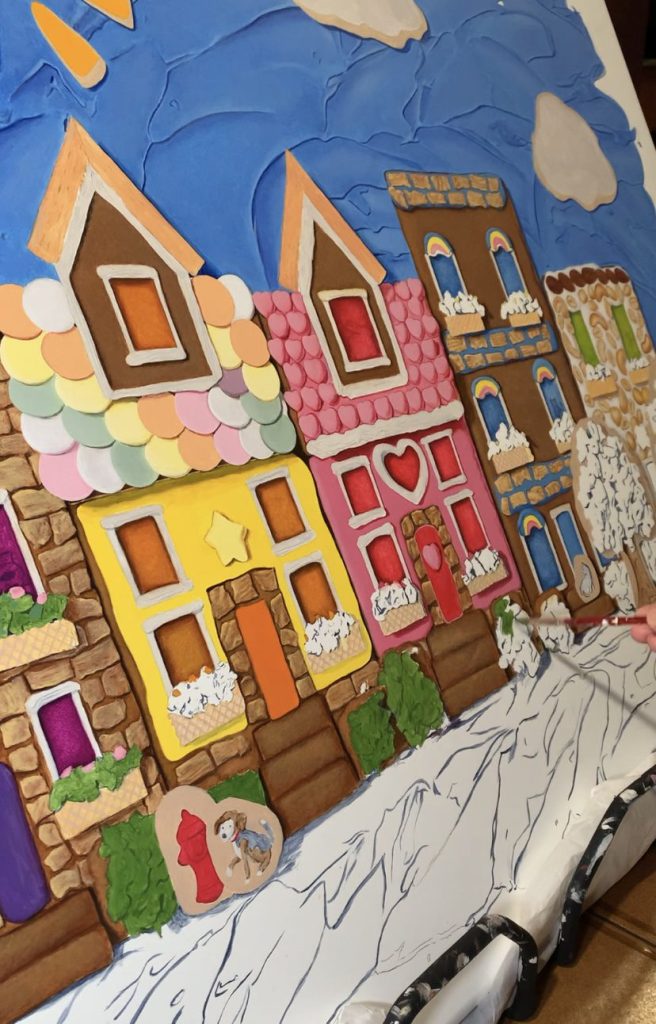
While you may often see videos of realism artists painting gracefully from left to right, in one very softly blended layer of paint, I paint in a completely different and very time-consuming way. Although this is partly because I work in acrylics, which dry very fast and don’t allow for much blending, I also think my approach lends itself to a high degree of realism and a much greater degree of dimension and illusion of texture, despite the paintings themselves being flat. It’s a very aggressive approach using constant brush marks with tiny brushes and multiple thin translucent layers of acrylic paint. The result is that virtually all of the layers of paint are visible, but they all peak through and interact with the other layers of paint. I rarely use traditional brushstrokes, and I rely a lot on how the light hits a painting to help aide in the illusion.
You can learn a bit more of my painting approach by watching my process videos on my TikTok, as well as checking out my blog post, “Painting a Beautiful Day in the Neighborhood Part 3: The Process.”
5. One of my favorite comments I’ve received online is…
I’ve had a few videos of my recent painting go viral on TikTok. The first one, a close-up of “The Daydreamer,” now has more than 420,000 views and many hundreds of kind comments. But one of my favorite comments — and there have been many! — was from a mom, who said she showed this painting to her little boy, and he said it was the most amazing painting he’d ever seen.
So yeah, it was all worth it.
My current exhibition will be up at Hidell Brooks Gallery in Charlotte, North Carolina, through March 27th. Hidell Brooks is by appointment only, so please contact them through their website to arrange a viewing.
- Showing 40-Plus Years of My Art on Twitch Today: Proof that Artists Can Progress… – July 24, 2026
- We’re Going to Paint a Tiny Ice Cream Bar on Twitch Today – June 15, 2026
- We’re a Go for Twitch Painting Livestreams – June 12, 2026


Leave a Reply